GIF Marketing, Brand Strategy
How Brands Use Custom GIFs to Increase Engagement and Conversions
Discover how branded GIFs and animated stickers help businesses capture attention, enter everyday conversations, and support measurable marketing growth.
By GIF Studios 10 min read
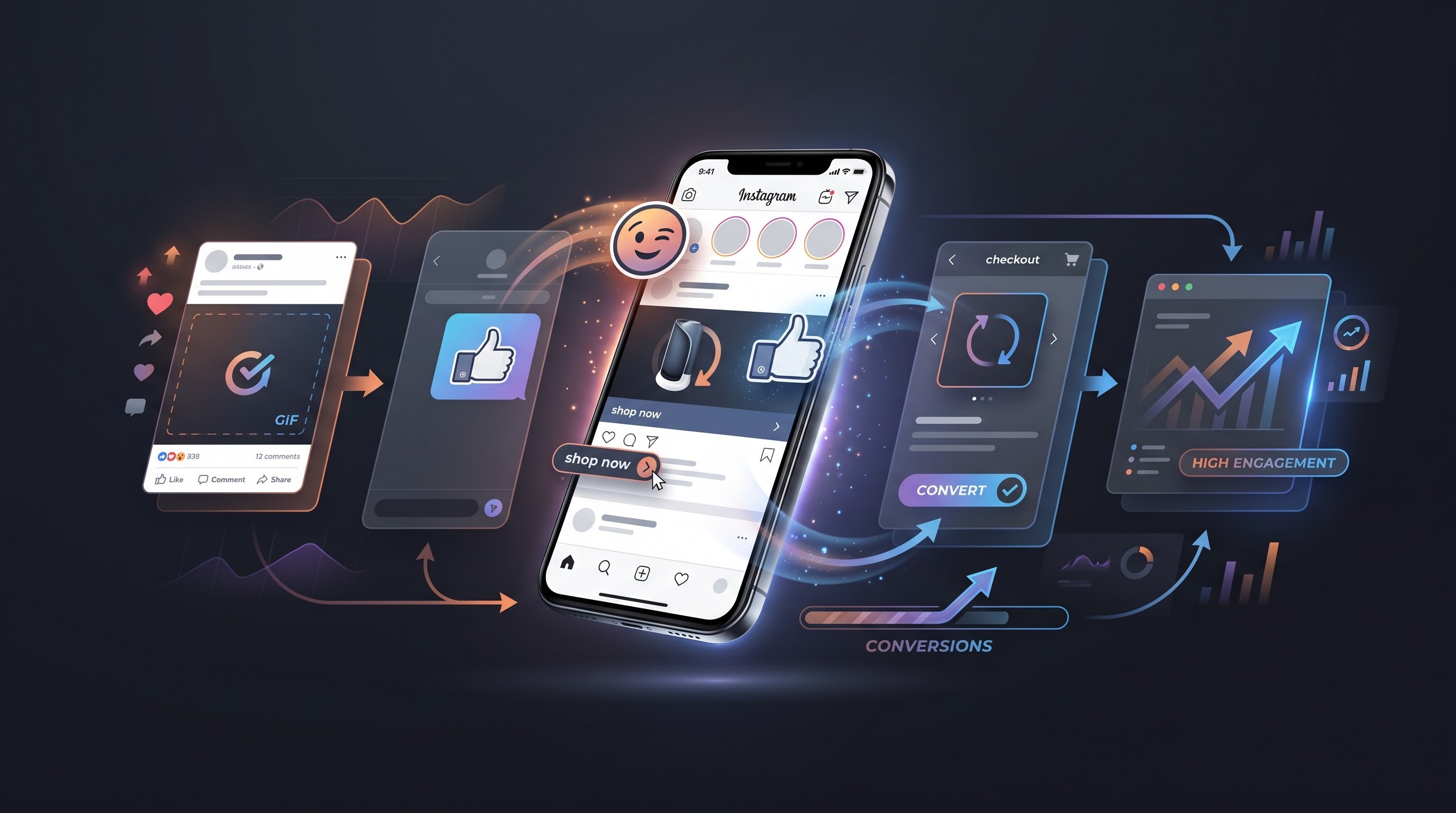
How Brands Use Custom GIFs to Increase Engagement and Conversions
People communicate online through reactions.
They send memes, stickers, emojis, short videos, and GIFs because these formats communicate emotion faster than a paragraph of text.
For brands, this creates an opportunity.
Custom GIFs allow a company to become part of the conversations its customers are already having. Instead of asking people to stop what they are doing and watch an advertisement, branded GIFs give them something useful, expressive, and easy to share.
When designed and distributed correctly, GIF marketing can increase engagement, strengthen brand recognition, and support conversions across social media, messaging platforms, websites, and digital campaigns.
What Are Custom Branded GIFs?
Custom branded GIFs are short looping animations created specifically for a company, product, campaign, character, or community.
They can include:
- Animated logos
- Product demonstrations
- Brand mascots
- Reaction GIFs
- Animated text
- Promotional messages
- Transparent animated stickers
- Seasonal campaign content
- Calls to action
- Creator or character animations
Unlike generic GIFs, branded GIFs are designed around a company's visual identity, audience, tone, and marketing goals.
A strong branded GIF should still feel natural enough for someone to use in a real conversation. If it looks too much like a traditional advertisement, people are less likely to share it.
Why GIF Marketing Works
GIFs communicate quickly
A good GIF can communicate a feeling, product benefit, or reaction within seconds.
Users do not need to turn on audio, read a long caption, or leave the conversation they are currently having.
This makes GIFs useful in fast-moving environments such as:
- Instagram Stories
- Group chats
- Social media comments
- Community platforms
- Customer support conversations
- Product pages
- Digital advertising campaigns
GIPHY-powered search distributes GIFs and stickers across platforms including Instagram Stories, WhatsApp, Snapchat, TikTok, and Facebook Messenger. Content uploaded through eligible upgraded channels can appear throughout GIPHY search and its API network. :contentReference[oaicite:0]{index=0}
Customers distribute the content
Most marketing content is distributed by the company that created it.
Custom GIFs work differently.
A customer can discover a branded GIF, select it, and send it to another person. The audience becomes part of the distribution process.
This creates repeated exposure without requiring the brand to publish the same post again and again.
The best branded GIFs are not simply advertisements. They are communication tools people genuinely want to use.
Repetition builds recognition
A single GIF may create only a small brand interaction.
However, a library of recognizable animations can repeatedly expose people to the same:
- Colors
- Characters
- Logo
- Product
- Message
- Brand personality
Over time, this consistency can make the brand easier to recognize across different platforms and conversations.
How Brands Use Custom GIFs to Increase Engagement
1. Creating branded reaction GIFs
Reaction GIFs are often the most reusable type of branded content.
A company can create GIFs around common emotions and phrases such as:
- Thank you
- Let's go
- Great job
- Congratulations
- Seriously?
- We did it
- Coming soon
- Sold out
- New launch
- Good morning
- Happy birthday
These GIFs can feature a mascot, founder, creator, product, or animated brand character.
The goal is to give users something they would naturally search for and send, even when they are not actively thinking about the company.
2. Turning products into shareable animations
Brands can demonstrate products through short animated loops.
Examples include:
- A skincare product opening and closing
- A shoe rotating
- An application feature being activated
- Food being prepared
- A product changing color
- Before-and-after transformations
- Packaging being revealed
- A character using the product
These animations can help customers understand a product without requiring a full video.
The strongest product GIFs focus on one action or benefit at a time. Trying to explain five features inside one short animation usually makes the message harder to understand.
3. Building animated sticker collections
Transparent stickers allow users to place branded animations over their own photos and videos.
A restaurant might create stickers for menu launches, celebrations, food reactions, and local events.
A software company might create stickers around productivity, launches, updates, and common workplace reactions.
An entertainment brand might create animated characters, quotes, expressions, and fan reactions.
GIPHY specifically supports searchable stickers across environments where it powers GIF search, including Instagram. Eligible brand channels provide broader search visibility than ordinary uploads. :contentReference[oaicite:1]{index=1}
4. Supporting seasonal campaigns
Seasonal and cultural moments give people a clear reason to search for relevant content.
Brands can create GIF collections around:
- New Year
- Valentine's Day
- Holi
- Diwali
- Halloween
- Christmas
- Product launches
- Sports events
- Award shows
- Industry events
- Internet trends
BACARDÍ, for example, used shareable Halloween GIFs designed to appear naturally in seasonal conversations across chats, threads, and comments. :contentReference[oaicite:2]{index=2}
The important part is relevance. Adding a logo to a generic holiday animation is rarely enough. The creative should connect the occasion with the brand's identity or product.
5. Strengthening creator and influencer campaigns
When a brand works with a creator, the campaign usually produces videos, posts, and photographs.
Custom GIFs can extend the life of that content.
Memorable expressions, gestures, quotes, and product moments can be converted into GIFs and stickers that continue circulating after the original campaign has ended.
This gives the creator's audience additional ways to interact with and share the campaign.
Before using creator footage in a GIF library, brands should ensure they have the necessary content and usage rights.
6. Making community communication more recognizable
GIFs can become part of a company's internal or external community language.
They can be used by:
- Community managers
- Customer support teams
- Sales teams
- Brand ambassadors
- Employees
- Creators
- Customers
A consistent collection makes replies feel more human while keeping the brand visible.
This works especially well for companies with a recognizable founder, mascot, character, or community identity.
How Custom GIFs Can Support Conversions
A GIF does not automatically produce a sale.
Its role is usually to attract attention, communicate value, create recognition, or move the customer toward the next action.
Demonstrating a product benefit
An animated product demonstration can make a landing page easier to understand.
Instead of explaining an interaction through several paragraphs, a short loop can show exactly how the product works.
This may reduce uncertainty before actions such as:
- Starting a trial
- Adding an item to a cart
- Installing an application
- Requesting a demonstration
- Completing registration
- Exploring a product feature
Drawing attention to a call to action
Subtle animation can direct attention toward an important action.
Examples include:
- Swipe up
- Shop now
- Try it
- New feature
- Join us
- Limited release
- Tap here
- Available now
The animation should support the main call to action rather than compete with it.
Reinforcing campaigns across multiple touchpoints
A customer may first see a branded GIF in a conversation, later encounter the same character in an Instagram Story, and finally recognize it on the company's website.
This repeated visual connection can make the campaign feel more familiar and coherent.
Official GIPHY case studies show that well-executed branded GIF campaigns can produce measurable commercial outcomes. A MUG Root Beer campaign reported a 4.1% weighted average sales lift across test markets. A Hardee's campaign reported engagement rates of 4.2% for food-related GIFs and 5.2% for holiday-focused content. These were specific paid campaigns, so their results should not be treated as guaranteed benchmarks for every brand. :contentReference[oaicite:3]{index=3}
How to Create GIFs People Actually Use
Focus on one idea
Each GIF should communicate one clear emotion, action, phrase, or product benefit.
Simple ideas are easier to understand and easier to reuse.
Make the first second clear
Users often decide quickly whether an animation matches what they were searching for.
The subject, text, or emotion should be understandable almost immediately.
Design for a clean loop
The end of the animation should connect smoothly with the beginning.
A distracting jump can make the GIF feel unfinished.
Keep branding recognizable but natural
Branding can appear through:
- Colors
- Characters
- Product shapes
- Typography
- Packaging
- Logos
- Visual style
The logo does not always need to dominate the animation.
The best balance allows the content to remain useful while still being recognizable.
Create a collection, not one isolated GIF
One GIF cannot cover every customer emotion, search term, or campaign moment.
A useful branded library may contain a mixture of:
- Evergreen reactions
- Product content
- Seasonal animations
- Brand phrases
- Stickers
- Campaign-specific creative
This gives the content more opportunities to match what users are searching for.
Building a GIF Search and Distribution Strategy
Creating the animation is only one part of the process.
Brands should also plan how the content will be uploaded, organized, tagged, distributed, and measured.
Set up an official brand presence
Companies that own their original content can apply for a GIPHY Brand Channel. Verified channels can appear in GIPHY search and receive access to brand-focused channel features. :contentReference[oaicite:4]{index=4}
Use relevant titles and tags
Metadata should describe:
- The emotion
- The action
- The object
- The occasion
- The brand
- The character
- The campaign
- Relevant phrases people may search
Avoid adding unrelated trending keywords. The objective is to match genuine user intent, not to force the content into irrelevant searches.
Distribute the collection
A brand can introduce its GIF library through:
- Social media posts
- Instagram Stories
- Creator campaigns
- Community announcements
- Website content
- Email campaigns
- Customer support
- Employee advocacy
- Launch campaigns
Customers may not know the content exists unless the company shows them how to find and use it.
Measure business impact
Do not judge a GIF strategy only through total views.
Track metrics such as:
- GIF views
- Shares and sends
- Engagement rate
- Sticker usage
- Branded searches
- Social mentions
- Website traffic
- Product-page engagement
- Assisted conversions
- Conversion rate
- Campaign revenue
GIPHY brand tools include access to channel analytics, which can help teams evaluate how uploaded content is performing. :contentReference[oaicite:5]{index=5}
Common GIF Marketing Mistakes
Brands often reduce performance by:
- Making every GIF look like an advertisement
- Using too much text
- Uploading only logo animations
- Creating content without considering search intent
- Using inconsistent branding
- Publishing one small collection and never updating it
- Ignoring transparent stickers
- Using unrelated or excessive tags
- Failing to promote the GIF collection
- Measuring only views instead of business outcomes
The objective is not simply to create movement.
The objective is to create useful branded expressions that people choose to include in their own communication.
Final Thoughts
Custom GIFs sit between content, communication, and distribution.
They help brands express personality, demonstrate products, participate in cultural moments, and become part of everyday digital conversations.
However, successful GIF marketing requires more than uploading a few animations.
Brands need:
- A clear creative strategy
- Useful and searchable content
- Consistent visual identity
- Proper channel setup
- Relevant metadata
- Active distribution
- Performance measurement
When these elements work together, custom GIFs can become reusable brand assets that support engagement, recognition, and conversion across multiple customer touchpoints.
GIF Studios helps brands create custom GIFs and animated stickers, establish their presence on GIF platforms, manage content libraries, optimize metadata, and build long-term GIF marketing campaigns.